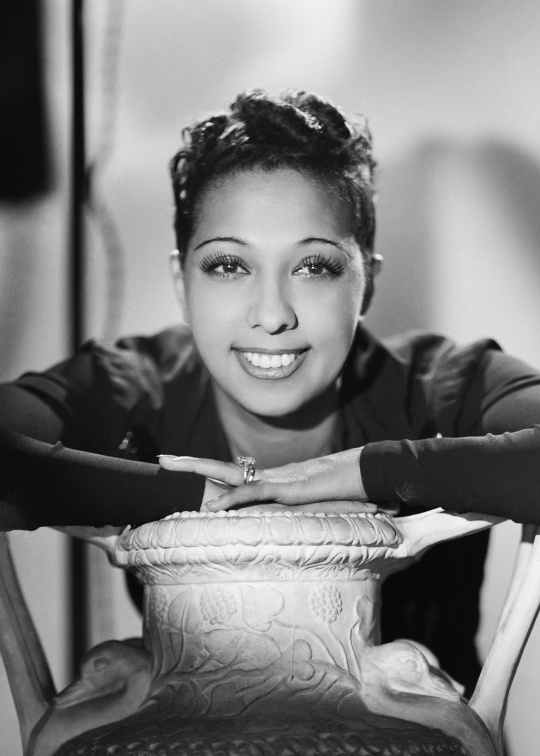
Josephine Baker’s European career was launched by her performance in La Revue Nègre, a musical that traveled to Berlin in 1926 during Baker’s first tour in Europe. Although she was stunned by the beauty and elegance of the theatre scene in Berlin and claimed to prefer this city to Paris, Baker returned to Paris at the end of this show’s tour.
Born in St. Louis, Missouri as the child of two performers, Baker had been surrounded by music and dance her whole life, and began performing at a young age. When her producer brought her to France in 1925, doors opened with many more opportunities than Baker had ever had in the US. La Revue Nègre was extremely successful and launched Baker’s career into something spectacular. Her style was risqué, sexual, and unapologetic: she embraced the spectacle of exoticism attributed to her and used it to her advantage.
Baker’s husband, Jean Lion, was Jewish, and in 1938, the year that Kristallnacht took place, Baker and her husband aligned themselves with the International League Against Racism and Anti-Semitism. Her unique position in society made her perfect for undercover work as Nazism began to rise because her career allowed her to move around freely, particularly near military bases. Aware of Baker’s mobility and anti-Nazi stance, her agent’s brother recruited her into the French military intelligence organization, La Deuxième Bureau, where she would inherit the title of “honorable correspondent.” Baker continued performing and smuggled messages in her lyrics that were sent back to France from opposing forces. Although she was not paid for this position, Baker didn’t care: she had a passion for activism and racial justice, and received the Croix de Guerre for her efforts.
Among many other skills, Baker was also trained as a pilot and flew Red Cross supplies into Belgium. But by 1940, Baker found that her celebrity status protected her less and less and, after discovering that a fellow African American performer, Valaida Snow, had been sent to a concentration camp during her tour in Copenhagen, Baker decided it was no longer safe for her to stay in Paris. She moved to southern France and died of natural causes in 1975.
– Keira Howard (University of Missouri)
Source:
Josephine Baker in 1940 via Wikimedia

Josephine Baker (1906-1975) by Keira Howard is licensed under a Creative Commons Attribution-ShareAlike 4.0 International License. Permissions beyond the scope of this license may be available at https://blackcentraleurope.com/who-we-are/.
 Black Central Europe
