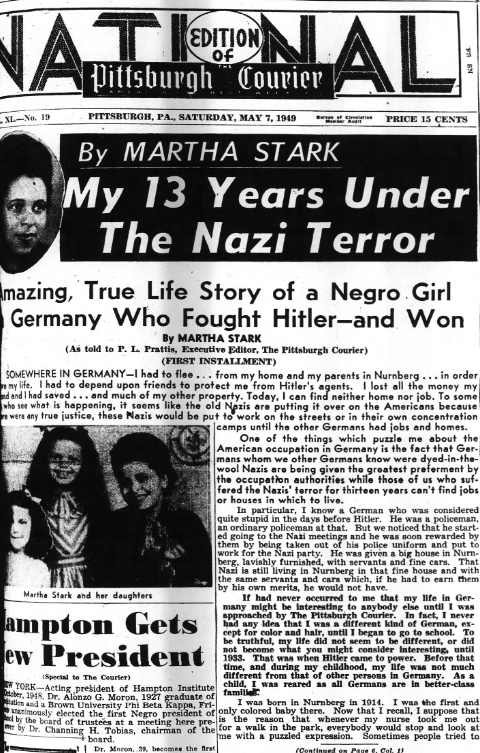
Martha Stark was an Afro-German woman who lived in Germany during the Nazi Era. She was born in 1914 in Nuremberg to a white German mother and an African American father and experienced both world wars by the time she was twenty-five. The Pittsburgh Courier published a nine-part account of Stark’s experience living under the Nazi regime, titled, “My 13 Years under the Nazi Terror: Amazing, True Life Story of a Negro Girl in Germany Who Fought Hitler—and Won.”
In her account, Stark recounts that, initially, she had watched as the Nazis targeted Jews in Nuremberg and throughout Germany, but that she had received support from local Germans and was not directly threatened.
Stark dated a white German lieutenant named Hermann Schwarz, though she was reluctant to tell her parents of their relationship because they had come to fear anyone in uniform. When Schwarz was denied a promotion because of his relationship with Stark, she ended things, though it pained her to do so.
Stark intended to be a doctor specializing in tropical medicine and to move to Africa to practice. She studied at the Humanities Gymnasium in Nuremberg for nine years before transferring to the University of Erlangen. On her first day of enrollment in 1934, she found that registration paperwork asked her about her affiliation with the Nazi party and required her to be pure Aryan.
Discouraged, she moved to Budapest, Hungary to continue her studies. She worked on cadavers in a lab on weekends with her professor, but attended business school and took a housekeeping course at a local castle owned by Baron Weisdorf. After leaving the castle, Stark met a friend of a friend named Herbert Stark, whom she later married.
Though Herbert insisted she give up her dream of traveling to Tibet for school, Martha became pregnant and decided to marry Herbert even if it meant forfeiting Tibet. But when Herbert and Martha went to obtain a marriage license, the Nazi city hall official questioned their marriage because Martha was Black. They questioned Martha and her friends and family for days, and eventually detained her in a cell.
Herbert and Martha had two children before divorcing in 1946. Martha got a job 45 minutes from her home, in Nuremberg, and hired a maid to watch her children. Martha’s retelling of her life in “My 13 Years Under the Nazi Terror” communicates the anxiety she felt, never certain that she was safe. She lived through both world wars by the time she was thirty, every milestone overshadowed by the threat of being apprehended by Nazis because she was Black. But she ultimately declares her time under the Nazi regime a victory.
– Sophia Anderson (University of Missouri)
See: Felicitas Rütten Jaima’s introduction to Martha Stark in Sara Lennox (ed.), Remapping Black Germany: New Perspectives on Afro-German History, Politics, and Culture (Amherst: University of Massachusetts Press, 2016), pp. 171-178.
 Black Central Europe